

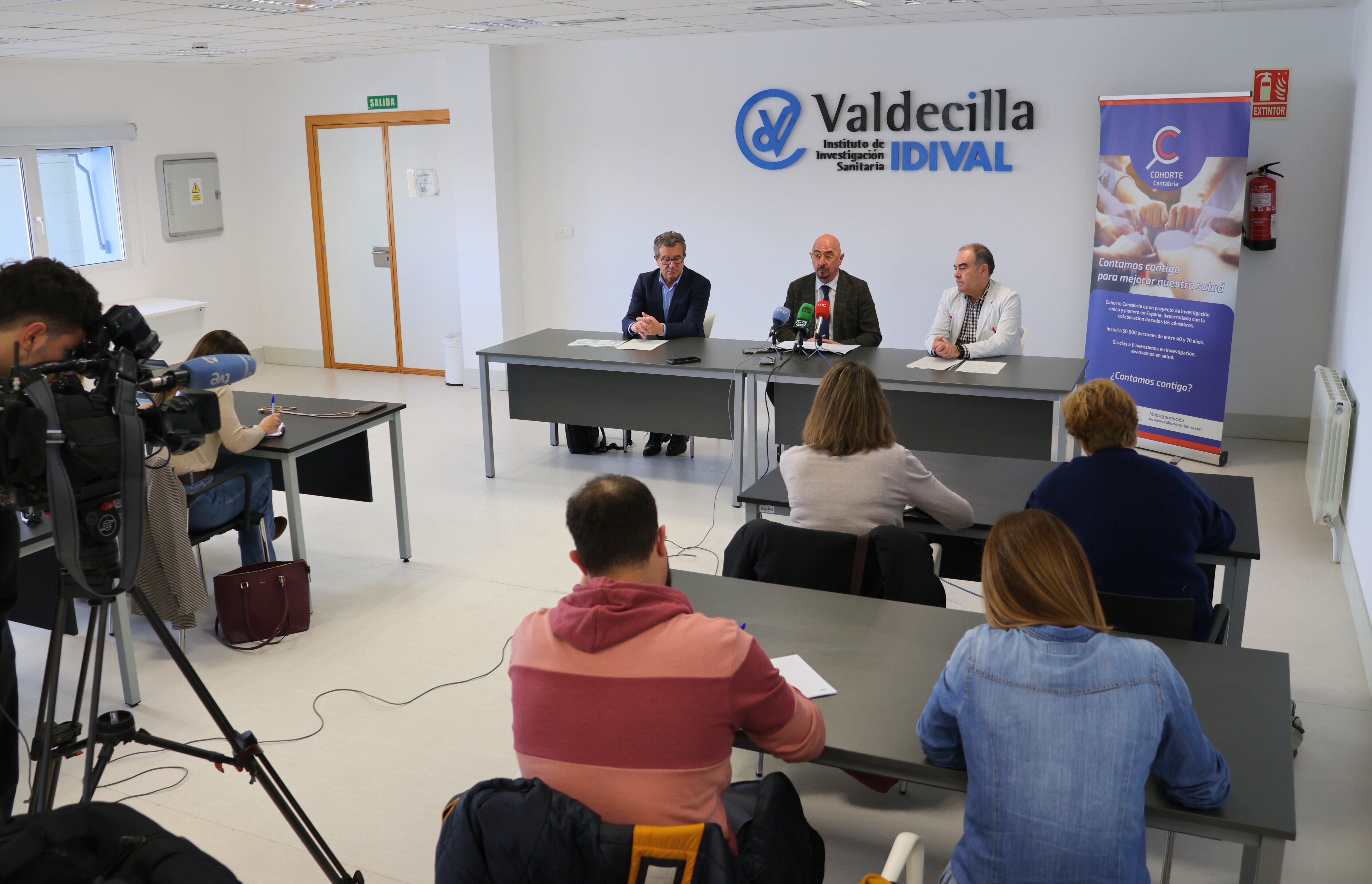

Cohorte Cantabria takes a decisive step toward public precision medicine
Cohorte Cantabria was made possible thanks to the voluntary participation of more than 51,000 people who chose to contribute, altruistically, to improving knowledge about health in our region. This civic commitment constitutes the essential foundation of the progress we present here.
The Government of Cantabria, the Marqués de Valdecilla Research Institute (IDIVAL) and Cohorte Cantabria will sign a scientific collaboration agreement with Regeneron Pharmaceuticals that will enable the incorporation of advanced genetic and proteomic analysis technologies into this public research infrastructure. Over the coming years, a high-resolution biological characterization will be completed, including the study of the functional portion of DNA—the exome—and the analysis of thousands of proteins present in blood. This information will be integrated with the clinical and longitudinal follow-up data that the cohort already collects over time.
This step does not represent an isolated initiative, but rather a structural evolution that transforms a well-established population cohort into an advanced public precision medicine platform. The integration of genetic, molecular and clinical information will make it possible to understand more deeply why some people develop certain diseases, how risk evolves over time, and which biological factors influence that evolution.
The positive implications of this agreement are multiple. For the volunteers, their participation gains an even greater scientific dimension, as they contribute directly to positioning Cantabria among the European regions with the strongest capacity in advanced population research. Their commitment strengthens a model in which the knowledge generated may, over time, improve prevention and health planning. In certain cases—and always under rigorous scientific validation and specific ethical approval—some findings could eventually have clinical utility. However, no individual results will be communicated unless they are supported by solid evidence and demonstrated medical relevance.
For society as a whole, this project represents an opportunity to strengthen the anticipatory capacity of the healthcare system. The integration of high-resolution biological information can progressively contribute to the development of more precise risk models, optimize preventive strategies, and allow more efficient planning of healthcare resources. It does not replace universal prevention policies, but it can make them more effective and better informed.
From a strategic perspective, the agreement positions Cantabria within the international ecosystem of large population research infrastructures, such as the UK Biobank and the All of Us Research Program. With this step forward, our region reaches scientific standards comparable to those of these internationally recognized precision medicine initiatives. This strengthens scientific competitiveness, facilitates the attraction of specialized talent, and opens new opportunities for high-level collaboration.
Medicine is evolving toward models that integrate genetic, molecular and clinical information to better understand risk and personalize preventive strategies. This agreement allows that evolution to take place within the public sector, with institutional oversight, ethical supervision, and social responsibility. The trust of our 51,000 volunteers is the most valuable asset of this project. That commitment requires transparency, scientific rigor, and institutional clarity in every step we take.
This is not about immediate or simplified solutions, but rather about a strategic investment in knowledge, developed with rigor and prudence, that can strengthen prevention and the healthcare system in the medium and long term. This agreement does not simply represent a technological expansion, but a strategic decision to integrate precision medicine and advanced biomedical research within the public sphere, oriented toward the common good.
Cantabria is therefore choosing to anticipate the future, to integrate science and the healthcare system, and to turn knowledge into a tool for collective improvement.
Audio completo de la rueda de prensa (25/03/2026): aclaraciones sobre la colaboración científica
News: